
Learning: How Second Language Acquisition Shaped My Perspectives
Hi! I’m Louise and I am from France, I grew up in a very rural and remote. I moved to Canada two years ago to study applied linguistics because I want to become a second language teacher. I started learning English when I was 11 and quickly became fluent thanks to my best friend, who was Scottish. We taught each other our respective languages and switched a lot between the two. I also took Spanish for 6 years through middle and high school, and took German classes at Uvic last year. Even though I have formally studied those three languages, my proficiency in each greatly varies. My language journey has therefore had a great impact on my vision of learning and how I relate to it. Moreover, having learned languages in the past helped me approach my German classes differently than my middle school Spanish lessons. I felt like I got a lot more from the former thanks to my experience.
In my opinion, learning should focus on application of skills or knowledge (learning a grammar book by heart doesn’t make one fluent). It is much more useful to be able to use your knowledge to adapt to a new situation or analyze a particular problem than to have the right answer on a test. I have also found that in my learning, intrinsic motivation was always the main drive.
The essential role of motivation
Motivation and memory
Motivation is the process by which we are driven to do something. It is generally divided into two types: intrinsic and extrinsic. Intrinsic motivation is triggered by the learner’s personal interest or curiosity in a particular topic, whereas extrinsic motivation finds its source in external factors. I started studying linguistics because I have a genuine and personal interest in the subject but I was motivated to get a job solely by the paycheck.
In educational settings, not only does learner motivation have a positive impact on both engagement and learning (Lei et al., 2024), but it also helps with working memory (Grogan et al., 2022). Learner motivation is not exactly something that an instructor can control with a specific design, but they can appeal to students with engaging stories or real world application. Research also finds that the nature of one’s motivation (intrinsic or extrinsic) does not influence its effects on memorizations (Duan et al., 2020).
Intrinsic motivation
In my experience, I have always needed intrinsic motivation and a personal link to a topic in order to effectively remember something. It feels as though my working memory only solidifies knowledge if I can personally connect to the content. Moreover, intrinsic motivation seems to positively influence my long-term memory, especially when learning a language. English had always fascinated me, it was the international language, the one that all my favorite celebrities and communities I wanted to be a part of spoke. I had no obligation to go beyond my classes, but I wanted to. And now, I use English without even thinking about it, I have fully acquired it. Spanish, on the other hand, was always a chore in my eyes. I did the bare minimum to avoid failing, learned vocabulary lists the day before the exam. I have now forgotten most of it. I know this is a personal experience, and not necessarily backed my research but it has greatly influenced my academic journey. I know that I will struggle more in a class if I don’t have a genuine interest in it.
Motivation in the classroom
In a language classroom, motivation is essential because it incentivizes communication. Students’ willingness to communicate with others is crucial to their ability to apply their language knowledge out loud, in real life situations. A myriad of studies have analyzed what gives a learner what it takes to express themselves in the classroom and tried to model this process. To this day, the most relevant source is MacIntyre et al.’s pyramid model of Willingness To Communicate (WTO) (1998).
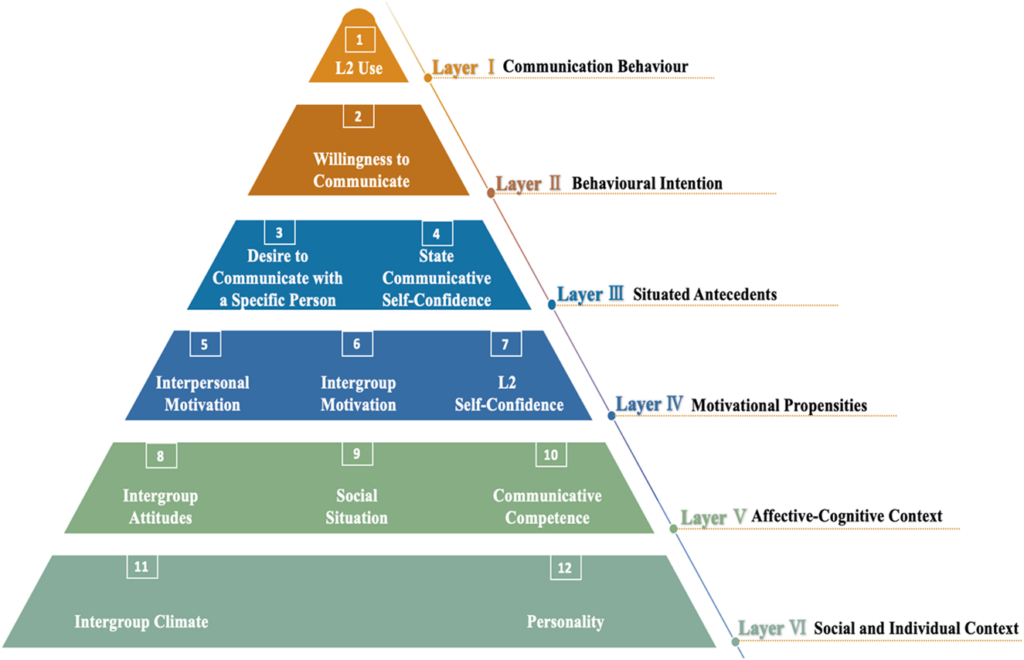
I think it perfectly highlights how complex the process is and where the instructor can come in to encourage communication (helping group dynamics or boosting confidence for example). Moreover, I think that this model can be extended to other classrooms, especially in mediating intergroup/individual relationships and attitudes or boost student self confidence.
Metacognition and thinking about our thinking
The final thing that I value greatly in learning is metacognition. It builds on the basis of cognitivism, which emphasizes the mental processes and structures needed to learn. Metacognition, literally meaning ‘thinking about thinking’, encourages this awareness in the learners themselves. In other words, it aims to make one analyze the process that they engage in when learning in order to monitor its results, change it if necessary and apply it to novel and challenging situations. When learning a language, I try to identify which aspects I might struggle with the most and adapt my study time. For example, in my first German class, I noticed that the conjugaison was similar to French, so I could spend less time on it and favor learning nouns’ grammatical genders because that was complicated.
This is a skill that instructors can actively improve in their students by making them think about their learning. Having students make an assignment schedule, break down/show approximate completion time or even have talks about learning strategies are all things that a teacher can organize so their students actively think about their own learning methods.
For more information on metacognition, I encourage you to watch this video!
Works cited:
MacIntyre, P. D., Dornyei, Z., Clement, R., & Noels, K. A. (1998). Conceptualizing willingness to communicate in a L2: A situational model of L2 confidence and affiliation. The Modern Language Journal, 82(4), 545. https://doi.org/10.2307/330224
Lei, H., Chen, C. & Luo, L. The examination of the relationship between learning motivation and learning effectiveness: a mediation model of learning engagement. Humanit Soc Sci Commun 11, 137 (2024). https://doi.org/10.1057/s41599-024-02666-6
Duan, H., Fernández, G., van Dongen, E., & Kohn, N. (2020). The effect of intrinsic and extrinsic motivation on memory formation: Insight from Behavioral and Imaging Study. Brain Structure and Function, 225(5), 1561–1574. https://doi.org/10.1007/s00429-020-02074-x
Grogan, J. P., Randhawa, G., Kim, M., & Manohar, S. G. (2022). Motivation improves working memory by two processes: Prioritisation and retrieval thresholds. Cognitive Psychology, 135, 101472. https://doi.org/10.1016/j.cogpsych.2022.101472